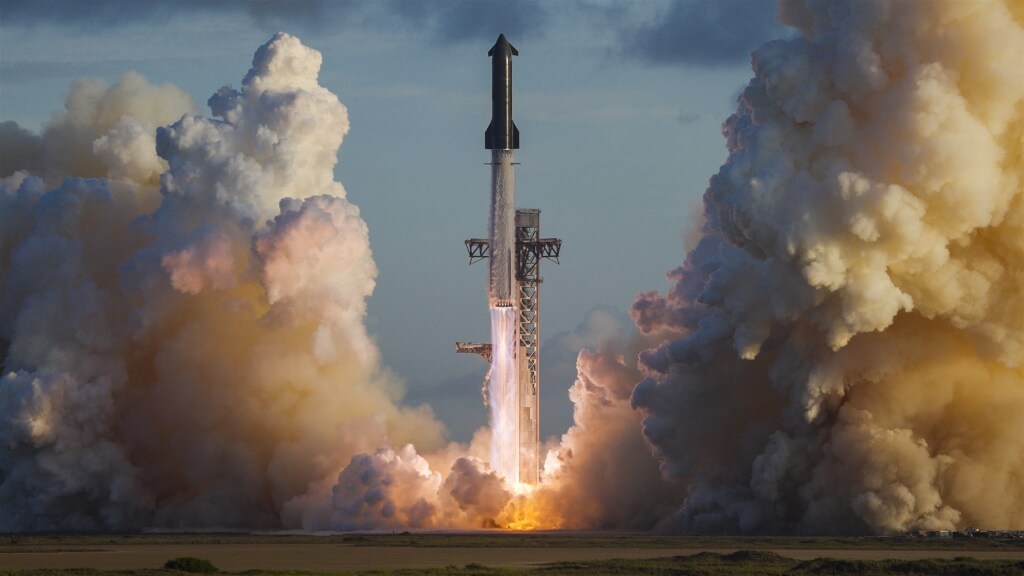
SpaceX Starship Finally Reaches Orbit on 14th Test Flight: Why It’s a Crucial Step
Since SpaceX first launched its massive “Starship” rocket in the spring of 2023, the company had been claiming for three and a half years that this towering stainless-steel machine would soon reach orbit. Today, SpaceX finally achieved that goal on its 14th launch attempt.
According to reports from Time magazine and Reuters, Starship reached orbit for the first time today and deployed next-generation Starlink satellites, marking a critical milestone in its 14th test flight. All 13 previous Starship test flights had only reached suborbital altitudes; successful orbital insertion is a key benchmark for any new rocket designed to deliver payloads into space.
Reaching Orbit After Over a Decade of Development: Starship Crosses a Critical Threshold
The development program has spanned nearly a decade and cost over $15 billion (approximately NT$478 billion) to date. SpaceX originally built Starship to launch Starlink satellites more frequently and to carry out future NASA moon missions.
At 9:15 a.m. Eastern Time, SpaceX announced on the social media platform X that “Starship has executed its orbital insertion burn and entered Earth’s orbit for the first time.” The spacecraft lifted off from Starbase in Texas and reached a near-circular orbit 170 miles above the ground in just 25 minutes and 17 seconds.
This success is highly significant for the long-term plans of both SpaceX and NASA. Starship is key to sending humans to the Moon and Mars and is central to SpaceX’s plan to replace its current workhorse, the Falcon 9 rocket. With a much larger payload bay capable of carrying nearly five times the cargo of a Falcon 9, Starship could consolidate multiple launches and drastically reduce costs in the future. Starship’s mission today combined the testing of a high-risk, next-generation rocket with actual operational activity; carrying Starlink satellites worth millions of dollars, it marked the vehicle’s first revenue-generating commercial mission.
Starship is a two-stage rocket system standing 407 feet tall at the launch pad. Its first-stage booster is equipped with 33 engines generating a total thrust of 16.7 million pounds—far exceeding the 8.8 million pounds produced by NASA’s Space Launch System (SLS)—making it the most powerful rocket currently in existence. The booster stage measures 236 feet in height, topped by the 171-foot Starship spacecraft itself.
In 2021, NASA selected Starship as one of two lunar landers intended to transport astronauts to the Moon—potentially as early as 2028—with the other being provided by Blue Origin, the company founded by Amazon’s Jeff Bezos. NASA plans to conduct crewed tests of one or both of these spacecraft in Earth orbit during the Artemis III mission, scheduled for 2027.
Starship’s early testing history was not without setbacks. During its maiden flight on April 20, 2023, the vehicle exploded and disintegrated just four minutes after liftoff; debris—including concrete and steel—scattered across nearly 400 acres of the surrounding Boca Chica State Park, and a fire broke out south of the launch site. Despite repeated lawsuits from environmental groups seeking to halt launches, test flights continued, culminating in today’s successful achievement of orbit.
However, today’s launch was not entirely free of complications. During the ascent, one of the Starship spacecraft’s three main engines shut down prematurely. SpaceX briefly announced during the live broadcast that reaching orbit might not be possible. Yet, after the engineering team confirmed that the remaining engines could compensate for the lost thrust, Starship successfully achieved orbital insertion.
Additionally, the return profile and mission schedule for this flight were streamlined. Unlike previous missions that utilized “chopstick” mechanical arms on the launch tower to catch the booster, this mission dispensed with that recovery method; instead, the first-stage rocket performed an engine-assisted soft landing on the surface of the Gulf of Mexico. Additionally, the flight mission—originally planned for six orbits lasting approximately ten hours—was cut short to three orbits due to an early engine shutdown.
Despite the shortened mission duration, Starship successfully deployed 26 next-generation Starlink satellites into orbit one by one, marking the vehicle’s first orbital satellite deployment. Founder Elon Musk confirmed on X that all 26 Starlink V3 satellites had been deployed and were functioning normally.
According to SpaceX, the V3 Starlink satellites deployed in this mission offer data transmission capacities up to ten times greater than the previous V2 Mini generation. Musk envisions that once Starship enters regular operations, it will launch V3 satellites in batches of 60, thereby accelerating the expansion of the broadband satellite network.
First Orbit Reached, but Crewed Moon Landing Remains a Challenge
Although Starship’s 14th launch represents just a small step in a long-term program, it is a crucial one. Significant adjustments are still required before the vehicle can undertake a crewed moon landing in 2028. Currently functioning essentially as a “giant flying truck,” the vehicle will need future modifications—such as environmental control systems and habitable living quarters—to accommodate a human crew.
Furthermore, the team must overcome the formidable challenge of orbital refueling: before heading to the Moon, the spacecraft must enter an Earth “parking orbit” and be fully refueled by up to 12 tanker ships of the same class. Prior to that, the Artemis III test flight scheduled for 2027, along with uncrewed lunar landing and liftoff tests, must be successfully completed before the vehicle can officially shoulder the responsibility of a crewed lunar mission.
Even so, SpaceX maintains that these high-profile Earth-orbit launches could eventually become as routine as the takeoffs and landings of commercial airliners. Musk has even spoken publicly about Starship one day reaching a launch cadence of once a day or even once an hour. For now, SpaceX is celebrating this inaugural orbital mission; after all, spaceflight is an endeavor that proceeds one careful step at a time, and today, SpaceX has indeed taken a major leap forward.